
A Lasting Legacy: Jackie & Rachel Robinson
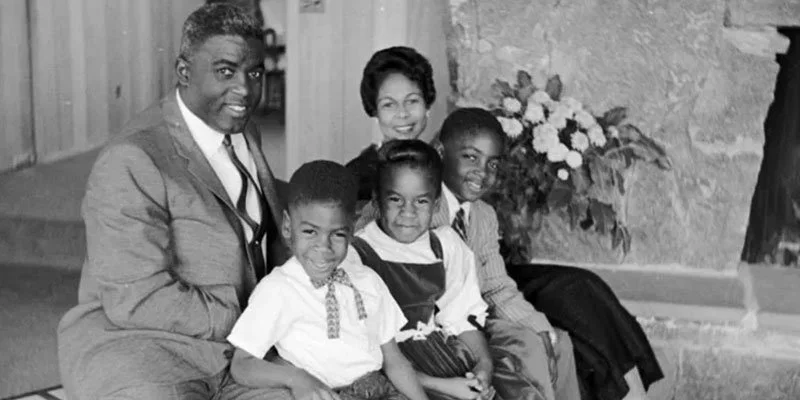
Jackie and Rachel Robinson along with their children.
By Mike Haskins
April marks a moment in baseball history and a watershed in American civil rights. It’s the anniversary of Jackie Robinson breaking the color barrier to become the first Black player in Major League Baseball, stepping onto the field for the Brooklyn Dodgers on April 15, 1947.
Seventy-nine years later, the magnitude of that achievement and the burden it carried remains staggering. Jackie’s story is often told as a singular accomplishment, the weight of progress born by one man who never sought to change the world, yet became a symbol of equal opportunity. He combined athletic brilliance with a level of patience, forbearance, and restraint that is almost unimaginable.
Yet there is another story. The story of a partnership, one that began long before Jackie became a household name, and one without which his accomplishments and their enduring impact would have been impossible. That partnership was with his wife, Rachel Robinson. Their story is as remarkable as his, and perhaps even more enduring.
They met in 1941 as students at UCLA, one of the few substantially integrated universities at the time. This was a meeting of equals, two young Black Americans navigating a world that often defined them as other. Jackie was already an athlete of renown, though in 1941, fame came without entourage, agents, or handlers. Financial constraints ended his studies by 1942, and like so many young men, he was drafted into the Army.
Their courtship deepened through letters. They discussed family, race, and the future. Jackie did not lean on Rachel emotionally; he consulted her. This mutual respect became a hallmark of their lives together, a partnership intertwined at its core.
Jackie served in a segregated Army and was initially denied officer candidate school. Only intervention by Joe Louis opened that door. He became a second lieutenant in 1943. In 1944, stationed in Texas, he refused to move to the back of a bus because of his race and faced court-martial. Acquitted, he had already proven that while he could endure extraordinary pressure with dignity, he would not accept humiliation as a baseline condition.
They married in February 1946. Uncertain futures lay ahead, but together they moved to Montreal, where Jackie joined the Royals, the Dodgers’ top farm team. Montreal offered relative normalcy. Fans embraced Jackie in ways American cities rarely did. Rachel was pregnant and gave birth to Jackie Robinson Jr. in November 1946. In hindsight, the name Jackie Robinson would soon be forever indelible.
In 1947, Jackie was chosen by Dodgers owner Branch Rickey to break baseball’s color barrier, not only for talent, but for maturity, life experience, and resilience. He accepted a burden that no one else could carry. Yet the focus on 42 in Dodger blue often eclipses the reality for Rachel, a new mother, two thousand miles from family, navigating a maelstrom of social upheaval, hostility, and death threats.
They moved often, living in hotels and temporary apartments, relying on friends and allies. Many landlords refused to rent to Black families. Jackie had baseball; Rachel carried the household. She packed and unpacked, tried to make each place feel like home, and shielded their family from the constant threat of instability. By 1948, they bought a home in St. Albans, Queens, not their first choice, but a place open to them in a segregated world.
After a ten-year career, Jackie retired. Unlike athletes today, he did not leave with generational wealth or security. With three children, Jackie Jr., Sharon, and David, he navigated a world without a major league pension, building new paths in business and advocacy. He became one of the first Black executives in a major company, vice president of Chock Full O’ Nuts, while also writing, speaking, and raising money for civil rights. Corporate life demanded a different kind of restraint than baseball. Advancement came without comfort.
At the center of it all, Rachel maintained her own professional accomplishments. She completed her master’s degree in psychiatric nursing at NYU in 1951, then taught at Yale Nursing School and administered operations at the Connecticut Mental Health Center. Her career was not merely a counterbalance to Jackie’s public life; it was the ballast that kept the family anchored.
By the late 1960s, Jackie’s health had declined sharply, including diabetes, heart complications, and the physical toll of years as an athlete. Hospitalized frequently, he continued advocacy work. At his final public appearance on October 15, 1972, he addressed the crowd with hope for the future, that one day a Black manager would stand on the third-base line, a symbol that equality in opportunity was possible. Nine days later, he died at 53.
The loss was compounded by the death of Jackie Jr. the year prior, a victim of addiction and the pressures of the era. Rachel was left to bear both grief and responsibility, a turning point that would define the next half-century of her life.
In 1973, she founded the Jackie Robinson Foundation. Not a continuation, not a joint project, she created it to preserve Jackie’s legacy and transform it into concrete opportunity for young people. Scholarships, mentorship, leadership development, and access to higher education for minority students became the mission. Over 50 years, the foundation has supported thousands of scholars, distributed tens of millions in aid, created professional networks, and extended its reach through digital platforms like JRF IMPACT. It has become a living, evolving embodiment of Jackie’s principles.
Rachel served as chair until 1996. Today, at 103, she continues to advise and guide the foundation, a living testament to resilience, dignity, and vision. Her work ensures that Jackie’s life did not end with him, but continues in the lives of every student she touches.
Celebrating Jackie Robinson without celebrating Rachel Robinson is incomplete. She did not stand behind him; she stood at his side, shoulder to shoulder, giving not one life, but two, one with him, one in service to generations that followed.
Click here to read this month’s issue or explore the Senior Voice Archives!
